New Ad 1

New 1

‏إظهار الرسائل ذات التسميات PMP. إظهار كافة الرسائل

الأربعاء، 1 أغسطس 2018

Tricky & Situational PMP Exam Questions - How to solve them

In PMP Exams, the Situational & Tricky questions constitute a huge part of the questions that could let you fail if you don't have any idea about how to deal with them. A clear strategy you have to follow when you are practicing real exams and when you take the PMP exam itself, below are some guidelines and strategies to follow at the exam:


1. Follow the rule of removing/Eliminating the wrong choices for the questions that you don't know their answer.


Usually, and out of 4 choices, there is at least 1 choice you can easily exclude or remove, and this choice usually is not complying with code of ethics & professional behavior, for example when you find one choice describe a penalty that was done directly by the PM to an employee or the PM has decided to remove a team member away from the project without investigation, such choices shall be considered as a wrong answer.


2. Read the answers first for the long questions.


You will encounter long questions in PMP exam, some of them with more than 9 rows, in these cases start reading the choices first then turn to the question itself, reading the choices in this case will give you an indication on what you have to emphasis and to give more attention, in such questions many extra information are given which you don't  need and you will not use them for solving the question, these distracted data can be easily discovered in lengthy questions when you start reading the choices.


3.  Answer all questions you see even if you don't know the right answer.


In PMP exam, you can mark the questions that you are not sure if you answered them correctly in order to check them later, Anyway DON'T LEAVE ANY QUESTION WITHOUT ANSWER, in case you are not sure about question(s), just mark them and choose the most suitable choice for you, many PMP students could not check their answers later as the time of the exam is limited and there is a big possibility that you will consume all of the time when you reach to question #200 !!


4. Memorize the ITTO for the 49 processes.


In PMBOK - Version 6, the processes increased up to 49 process, around 12 direct questions in PMP exam are about Inputs, Tools & Techniques and the outputs of these 49 processes, you have to be sure that you are memorizing them before starting the exam.

See Also: The Main Formulas you have to memorize for PMP Exam - Version 6
http://academyoflions.blogspot.com/2018/07/main-formulas-you-have-to-memorize-to.html

5. Be careful about the first 4-5 questions in the exam.


Many PMP students who failed PMP exam were complaining about the beginning of the exam's questions as they have faced questions they don't even hear about, don't panic! there are 25 questions in PMP exam will be removed before calculating your final test result, some exams start in a difficult & unclear questions to check the students against the hard times and if they can keep calm & overcome these impediments.


6. Read the end of the questions CAREFULLY.


At the end of most questions you will see words like the Best, Except, Most Likely, Least likely, Not .. etc , don't go fast to the answers until being sure that you have read the last one or two words in the question.


7. Use the 15 minutes Tutorial.


You will be given a 15 minutes before starting the exam to clarify the way the exam will be performed, these 15 minutes are in fact long time for exam clarification, you can also check some videos on youtube to know more about this tutorial, at maximum you will need 5 minutes out of 15, the remaining 10 minutes you can use to write the equations, ITTO's and any other thing you have a difficulty in memorizing, you will be provided with a pencil and papers at the beginning of the exam, use them to write down the aforementioned points. 


8. Practice real exams before sitting for your one.


You can use the link below to test your self, it contain a real PMP exam with 200 questions, you will find the answers at the end of the exam.


http://academyoflions.blogspot.com/2016/11/free-pmp-online-training-course.html


9. Memorize the Planning processes in ORDER.


Many questions you will see in PMP exam asking about what happened next? or what is the next process that the PM shall perform? in planning, the processes are coming in order (chronologically), for example: the process that shall come after qualitative risk Analysis is the quantitative risk Analysis, and so on for all planning processes.


10. Read all answers before you choose the correct one.


Usually, PMP exam's questions have 2 right answers and you have to choose the most correct one, don't choose the answer just because you have read it, take a look to all choices before you choose your one, this trick led many students fail the exam at first trail.


الأربعاء، 18 يوليو 2018

Main Formulas you have to memorize to pass PMP Exam - Version 6


Below are the main formulas that shall be memorized for PMP - Ver. 6 Exam:

1. Standard Deviation (SD)


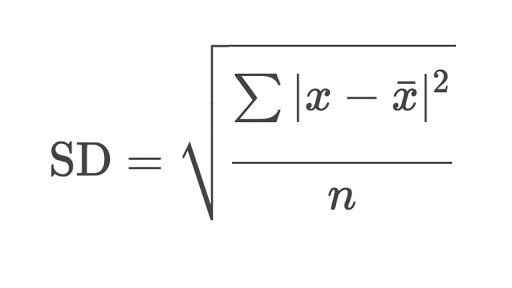
SD is a way to measure how much is the variation from the mean. 


usually it is used to analyze data. Standard Deviation is represented by using the symbol sigma (σ).
Sigma is the difference of distribution values on any end and in middle.
σ = (Pessimistic – Optimistic) / 6
A low value of SD shows that the data points are close to mean or average and a high value of SD shows that data points are spread over a large range.
Image result for standard deviation

2. Earned Value

specific technique in which the actual values of the work related performance is calculated for any and all particular work components and of schedule activities
Earned Value = % complete × Budget at Completion (BAC)
For example, if the project team has completed 100 man-hours of work and project required 500 man-hours of work to complete the project, then
% Complete = 100/500 × 100 = 20%
Budget at Completion = Total budget assigned for the project (let it be $50,000 in this case)
Then, EV = 20 × $50,000 = $10,000

3. Schedule Variance (SV)

It is the difference between the earned value and the planned value. 
Schedule Variance = Earned Value (EV) – Planned value (PV)
For example, if EV for an app development project is $40,000 and PV is $50,000 then
Schedule Variance = $40,000 – $50,000 = – $10,000 (which shows that project is running behind the schedule by $10,000 schedule variance)
** Negative value of SV shows that the project is behind the Schedule 
** Positive value of SV shows that the project is ahead of the Schedule.
** Zero SV means that the project is exactly at the Schedule.

4. Schedule Performance Index (SPI)

It is a ratio of the earned value to the planned value. 
SPI = Earned Value (EV) / Planned Value (PV)
 As the same of CPI, it is also a ratio then it can have three values (=1, >1 or <1)
If SPI = 1, it indicates that project is going at the same rate as expected.
If SPI > 1, it indicates that project is going at a faster rate.
If SPI < 1, it indicates that project is going at a slower rate.

5. Cost Variance (CV)

It is the difference between earned value and actual cost.
Cost Variance (CV) = Earned Value (EV) – Actual Cost (AC)
For example, If Earned Value (EV) and Actual Cost (AC) for a project are $75,000 and $60,000 respectively then
Cost Variance = $75,000 – $60,000 = $15,000
The positive of Cost Variance shows the condition of under budget whereas the negative value of Cost Variance denotes the over budget.
The value of zero for the cost variance shows that the project is exactly at the budget.

6. Cost Performance Index (CPI)

It is the ratio of earned value to the actual cost.
CPI = EV / AC
CPI can have three values (=1, >1or <1)
If CPI = 1, then it means that the project is getting $1 for every $1 spent.
If CPI > 1, then it means that he project is getting more than $1 for every $1 spent.
If CPI < 1, then it means that he project is getting less than $1 for every $1 spent.

7. Estimate at Completion (EAC)

It is a forecasting technique to predict the future project performance. 

 There are four Equations to calculate EAC.
1st Equation of EAC
Estimate at Completion (EAC) = BAC / CPI
If CPI = 1 then EAC = BAC which means that the project manager are able to complete the project within the provided budget and without any forecasting analysis. Even at the starting of the project, estimate at Completion is same as that of the Budget at Completion.
2nd Equation of EAC
When the project cost estimation was flawed and the project manager wants to find the new cost estimate for the remaining works, you need to move to the activity level in order to find the cost of each activity, and then add individual costs to obtain the total cost value of the remaining works. In this case,  the following formula is used to calculate the EAC
Estimate at Completion (EAC) = AC + Bottom-up ETC
3rd Equation of EAC
If a deviation happened from the estimated budget but now the project manager can perform the remaining task as per plan. This may happen because of an unexpected condition or increased in cost. so, to calculate the value of EAC in this formula, money spent to date is added to the budgeted cost for remaining project works.
Estimate at Completion = Money spent to date + Budgeted cost for the remaining work
Estimate at Completion (EAC) = AC + (BAC – EV)
4th Equation for the EAC
In this equation, both the schedule and cost are required to be taken into consideration,  this formula is applied to find the value of EAC. It is given as:

Estimate at Completion (EAC) = AC + [(BAC – EV) / (CPI × SPI)]
Estimate at Completion = Money spent up to date + (Budgeted cost for the remaining works – Earned Value) / (Cost Performance Index × Schedule Performance Index)
Image result for estimate at completion formulas

8. Variance at Completion (VAC)

It is the difference of Budget at Completion and Estimate at Completion.
Variance at Completion (VAC) = BAC – EAC
Remember that a $0.0 value for VAC indicates that the project will hit the budget. A value less than $0.0 indicate that the project will be over budget and a value more than $0.0 shows that the project will be under/lower than the budget.

9. Estimate to Complete (ETC)

It is a way demonstrates which value that shall be spent on the remaining works for the project to get the project completed. 
ETC = EAC – AC

10. To Complete Performance Index

It is a measurement for the cost performance that is required to be achieved with the remaining resources in order to meet a specified management target.

There are two ways to calculate the TCPI as stated below:
TCPI = (BAC – EV) / (EAC – AC)
TCPI = (BAC – EV) / (BAC – AC)

11. Communication Channels (CN)
The number of ways by which information flows within the organization or Company.
 communication channels = n (n – 1) / 2
Where ‘n’ stands for the number of stakeholders
If there are 7 stakeholders,  then the number of communication channel is = 7 (7-1) / 2 = 21 channels 
(Remember that a stakeholder may be an individual, a group or an organization that is affected by the decision, activity or result of the project)

** Remember that usually there is 1 direct question about this formula in PMP exam.

الثلاثاء، 5 يونيو 2018

How Many People in the World are PMP Certified & How many in other Certifications

Project Management Institute (PMI) Certifications became so popular and accredited around the world, each year the number of the certified people is increasing due to the reputation and the well-recognition of PMI, below are a statistical data for the main PMI certifications' holders up to 1st January 2018:


PMP® – There are 825,413 (Project Management Professional Certified around the World)

** Top countries that have PMP holders are:
1. United States .. more than 250,000 Holder
2. China .. more than 100,000 Holder
3. India .. more than 50,000 Holder
4. Japan .. more than 40,000 Holder
5. Canada .. more than 30,000 Holder


CAPM® –  Around 35,000 (Certified Associate in Project Management)


PMI-ACP® – Around 18,000 (PMI® Agile Certified Practitioner)

PMI-RMP® – Around 5,000 (PMI® Risk Management Professional)

PMI-SP® – Around  2,000 (PMI® Scheduling Professional)

PgMP® – Around 2,000 (Program Management Professional)

PMI-PBA® – Around 2,000 (PMI® Professional in Business Analysis)

PfMP® – Around 500 (Portfolio Management Professional)

الأربعاء، 30 مايو 2018

Critical Path Method in PMP Exam

Critical Path Method (CPM)
Critical Path is the LONGEST duration path through a network diagram and determines the shortest or earliest time to complete the project.

The Critical path is calculated by Adding up the duration's of activities of each path in a network diagram. The longest path is the critical path (The longest path duration = The shortest time
a project takes to finish all its activities).


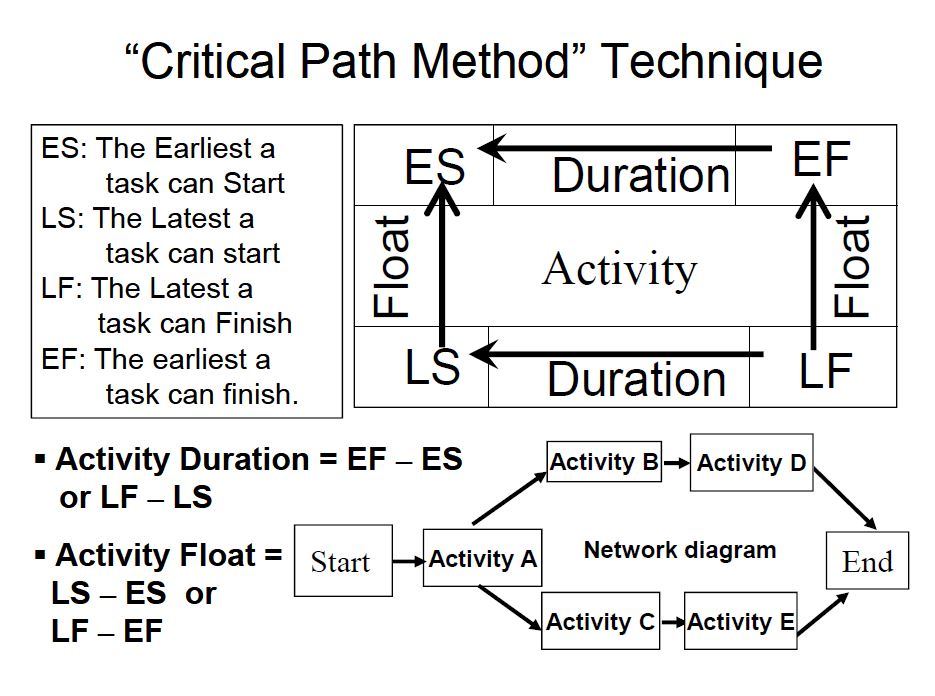
This technique calculates theoretical EARLY start & Finish dates( ES & EF ) and LATE Start & Finish ( LS & LF) dates ,for all activities Regardless for any resource limitations.

Calculations of ES,EF : performing a forward pass analysis through the schedule network [from the beginning of the project to the task and following the dependencies in the network diagram].

Calculations of LS, LF: performing a backward pass analysis through the schedule network. [from the end of the project to the task and following the dependencies in the network diagram].


Most Project Management software's calculate ES EF LS LF for you, but you must be able to calculate
them manually on PMP exam.


The resulting dates ( ES,EF,LS,LF) are not necessarily the schedule
network; rather, they indicate the followings:

- TIME PERIODS within which the schedule activities could be scheduled.
-  Given activity duration
- Logical relationships.
- LEAD & LAG and other known constraints.
- Calculating ES,EF,LS,LF may be affected by the activity Total Float.


Total Float (slack): The amount of time that a schedule activity may be delayed from its early start date without delaying the project completion date or violating a schedule constraint.

Total Float is termed as schedule flexibility and is measured by the
positive difference between Early and Late dates (LF-EF or LS-ES).


  •  Total float may be Positive(we can wait), Negative(We need to speed up the Work on this activity) or Zero(No any delay).
  •   The “critical path” has either Zero or Negative total float. But critical path is normally characterized by Zero total float on the critical path.
  •   Adjustments to activity duration, logical relationships, leads and lags or other schedule constraints may be necessary to produce network paths with a zero or positive total float.

􀂉 The activities in the critical path are called “Critical Activities” and almost always have no slack (Slack=0)
􀂉 The total float provides schedule flexibility.

Once the total float for a network path has been calculated then the Free float can also be determined.

􀂃􀂃 Free Float (Slack): The amount of time that an activity can be delayed without delaying the early start date of any immediate successor activity within the network path.
􀂃􀂃 Project Float (Slack): The amount of time a project can be delayed without delaying the externally imposed project completion required by the customer, sponsor or management.
􀂃􀂃 Near Critical Path: a Path with low float. A network diagram can have

multiple near critical paths.

Free PMP Exam 
http://academyoflions.blogspot.com/2016/11/free-pmp-online-training-course.html
Float is extremely useful for:

– The project manager: Better allocation of rescourses among other areas of the project.

– Team members: To juggle multiple projects  
􀂃􀂃 The critical Path Method technique has the following benefits:
􀀹􀀹 It proves the project time estimate.
􀀹􀀹 It helps project compression.
􀀹􀀹 It indicates where to focus and what to monitor.
􀀹􀀹 It indicates what could be delayed.
􀀹􀀹 It Shows what requires immediate action.

􀀹􀀹 PM should monitor & control the Near–Critical Path as well.

Example I:


- In order to solve such questions which appear always in PMP exam, first you have to determine the possible paths exist in the chart.

(Start) - A-B-C-D-E-K - (End)

(Start) - A-B-F-G-H-J-K - (End)

(Start) - A-B-I-J-K - (End)

- Second step is to determine the length of each path based on the duration gived in the chart for each activity:

(Start) - A-B-C-D-E-K - (End)  *31 Days*

(Start) - A-B-F-G-H-J-K - (End) *43 Days*

(Start) - A-B-I-J-K - (End) *33 Days*

- So based on the definition of the Critical Path which is the LONGEST duration path through a network diagram, the critical path will be the second path : (Start) - A-B-F-G-H-J-K - (End) 


Example II:


- First Step: draw the network diagram :

- Second Step: determine the Critical path:
                        

- Third Step: determine the ES, EF, LS & LF for each activity:


- Now it is easily to calculate the float for each activity as the ES, EF and LS, LF are known for all activities.

الخميس، 24 نوفمبر 2016

The Most Important Equations in Cost Management in PMP & in PMI-ACP Exams


Cost Variance (CV)
CV = EV – AC
EV = Earned Value
AC = Actual Cost
< 0    Over budget
= 0    On budget
> 0    Within budget


Schedule Variance (SV)
SV = EV – PV
EV = Earned Value
PV = Planned Value
< 0    Behind schedule
= 0    On schedule
> 0    Ahead of schedule
Cost Performance Index (CPI)
CPI = EV/AC
EV = Earned Value
AC = Actual Cost
< 1    Over budget
= 1    On budget
> 1    Under budget

sometimes the term ‘cumulative CPI’ would be shown, which actually is the CPI up to that moment


Schedule Performance Index (SPI)
SPI = EV/PV
EV = Earned Value
PV = Planned Value
< 1    behind schedule
= 1    on schedule
> 1    ahead of schedule
Estimate at Completion (EAC) if original is flawed
EAC = AC + New ETC
AC = Actual Cost
New
ETC = New Estimate to Completion
if the original estimate is based on wrong data/assumptions or circumstances have changed
Estimate at Completion (EAC) if BAC remains the same
EAC = AC + BAC – EV
AC = Actual Cost
BAC = Budget at completion
EV = Earned Value
the variance is caused by a one-time event and is not likely to happen again
Estimate at Completion (EAC) if CPI remains the same
EAC = BAC/CPI
BAC = Budget at completion
CPI = Cost performance index
if the CPI would remain the same till end of project, i.e. the original estimation is not accurate
Estimate at Completion (EAC) if substandard performance continues
EAC = AC + [(BAC -EV)/(CPI*SPI)]
AC = Actual Cost
BAC = Budget at completion
EV = Earned Value
CPI = Cost Performance Index
SPI = Schedule Performance Index
use when the question gives all the values (AC, BAC, EV, CPI and SPI), otherwise, this formula is not likely to be used
To-Complete Performance Index (TCPI)
TCPI = (BAC –EV)/
(BAC – AC)
BAC = Budget at completion
EV = Earned value
AC = Actual Cost
TCPI = Remaining Work
/Remaining Funds
BAC = Budget at completion
EV = Earned value
CPI = Cost performance index
< 1    Under budget
= 1    On budget
> 1    Over budget
Estimate to Completion 
ETC = EAC -AC
EAC = Estimate at Completion
AC = Actual Cost
Variance at Completion
VAC = BAC – EAC
BAC = Budget at completion
EAC = Estimate at Completion
< 0    Over budget
= 0    On budget
> 0    Under budget
PERT Estimation (3 Points Estimate)
(O + 4M + P)/6
O= Optimistic estimate
M= Most Likely estimate
P= Pessimistic estimate
Standard Deviation
(P – O)/6
O= Optimistic estimate
P= Pessimistic estimate
this is a rough estimate for the standard deviation
Float/Slack
LS – ES
LS = Late start
ES = Early start
LF – EF
LF = Late finish
EF = Early finish
= 0    On critical path
< 0    Behind schedule


Communication Channels
n (n-1)/2
n = number of members in the team
n should include the project manager

e.g. if the no. of team members increase from 4 to 5, the increase in communication channels:
5(5-1)/2 – 4(4-1)/2 = 4


One Point Estimate
(O + M + P)/3
O= Optimistic estimate
M= Most Likely estimate
P= Pessimistic estimate


K4

Most Repeated Topics in Reading Section in TOEFL Exams

Reading Section is one important part in both IELTS & TOEFL Exams which constitute 25% of the overall score in exam. After studying Hun...

text ad

Sidebar

lacademy